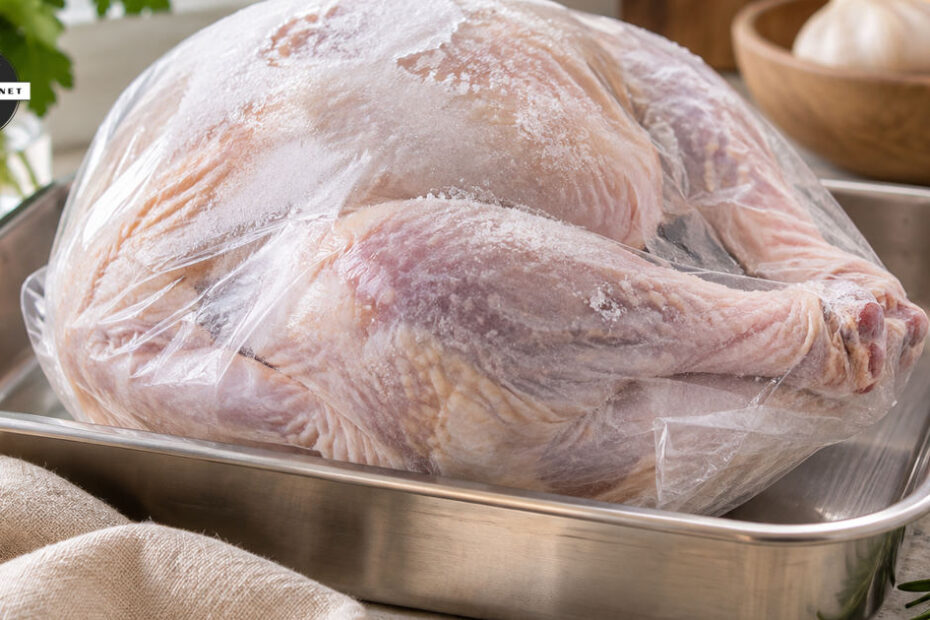
A frozen turkey takes about 24 hours to thaw for every 4 to 5 pounds of weight in the refrigerator. That means a 12-pound turkey needs roughly three days, while a 20-pound turkey can take five days. If you’re short on time, cold-water thawing is much faster, requiring about 30 minutes per pound.
The key is planning ahead and keeping the turkey at a safe temperature while it thaws. Here’s how to calculate your thawing time, choose the right method, and handle a turkey that’s still frozen when you’re ready to cook.
- Refrigerator thawing takes several days, depending on the turkey’s weight, but requires very little hands-on work.
- Cold-water thawing is significantly faster, although it requires frequent water changes and immediate cooking.
- You can safely roast a turkey that’s still partially or completely frozen, provided you adjust the cooking time.
Turkey thawing time chart by weight
The easiest way to estimate thawing time is to start with your turkey’s weight. Use these guidelines for a whole frozen turkey.
| Turkey weight | Refrigerator thawing | Cold-water thawing |
|---|---|---|
| 4–8 pounds | 1–2 days | 2–4 hours |
| 8–12 pounds | 2–3 days | 4–6 hours |
| 12–16 pounds | 3–4 days | 6–8 hours |
| 16–20 pounds | 4–5 days | 8–10 hours |
| 20–24 pounds | 5–6 days | 10–12 hours |
| 24–28 pounds | 6–7 days | 12–14 hours |
These times assume your refrigerator stays at 40°F or below and your cold-water bath stays cold throughout thawing. A turkey may need a little longer if your refrigerator runs particularly cold or the bird is packed tightly among other foods.
If you’re planning a holiday meal, I recommend allowing an extra day for refrigerator thawing. A fully thawed turkey can safely remain refrigerated for another one to two days before cooking, so a little extra time is better than discovering a frozen center on Thanksgiving morning.
Method 1: Thawing a turkey in the refrigerator
Refrigerator thawing is the safest and easiest method for most home cooks. It requires almost no attention, and you can keep the turkey refrigerated for a day or two after it’s fully thawed.
The downside is that it takes several days, especially for larger birds. You’ll also need enough refrigerator space to hold the turkey while it defrosts.
How to thaw a turkey in the refrigerator
Keep the turkey wrapped. Leave the turkey in its original packaging. If the wrapper is torn or leaking, place the bird inside a food-safe bag.
Place it in a pan. Set the wrapped turkey on a rimmed baking sheet or in a roasting pan to catch any liquid. Choose a pan large enough to contain leaks without spilling.
Refrigerate. Put the turkey on the lowest refrigerator shelf, where drips can’t contaminate other foods. Keep the refrigerator at 40°F or below.
Allow enough time. Plan on 24 hours for every 4 to 5 pounds of turkey. For example, a 16-pound turkey generally takes four days to thaw completely.
Check before cooking. Once thawed, the turkey should feel pliable, and you should be able to remove the neck and giblet package from the cavity. Small ice crystals may remain, but the bird shouldn’t have a hard, frozen center.
How long can a thawed turkey stay in the refrigerator?
A turkey thawed in the refrigerator can remain there for one to two additional days before cooking. This gives you some flexibility if your meal plans change or the turkey finishes thawing earlier than expected.
You can also refreeze a refrigerator-thawed turkey without cooking it first, provided it has remained properly refrigerated. There may be some loss of quality, but it’s safe from a food-handling standpoint.
Method 2: Thawing a turkey in cold water
Cold-water thawing is a good backup when you don’t have several days to spare. It takes about 30 minutes per pound, which means a 12-pound turkey can thaw in approximately six hours.
However, this method requires more attention than refrigerator thawing. You’ll need to keep the turkey submerged in cold water, change the water regularly, and cook the bird immediately after thawing.
How to thaw a turkey in cold water
Check the packaging. Make sure the turkey is sealed in a leakproof wrapper or food-safe plastic bag. Water entering the package can introduce bacteria and affect the meat’s quality.
Fill a container. Use a clean sink, large pot, or food-safe cooler filled with cold tap water. The container must be large enough to submerge the turkey completely.
Submerge the turkey. Place the wrapped bird in the water, breast-side down. Use a clean plate or other food-safe weight if necessary to keep it submerged.
Change the water. Drain and replace the water every 30 minutes to keep it cold. Don’t use warm or hot water to speed things up.
Allow 30 minutes per pound. A 10-pound turkey needs approximately five hours, while a 20-pound bird needs about 10 hours. Larger birds can take most of the day.
Cook immediately. Once the turkey is fully thawed, prepare and cook it right away. Don’t put it back in the refrigerator for another day or two as you would with a refrigerator-thawed turkey.
Can you thaw a turkey in a cooler?
Yes, provided you can keep the water cold and change it every 30 minutes. A clean, food-safe cooler can be useful for larger birds that won’t fit comfortably in your kitchen sink.
The cooler should not be treated as a substitute for refrigeration unless you’re actively monitoring the temperature. Keep the turkey sealed and submerged, and follow the same 30-minutes-per-pound guideline.
Method 3: Thawing a turkey in the microwave
Microwave thawing is technically an option, but it’s usually impractical for a whole turkey. Most household microwaves aren’t large enough to accommodate a 15- or 20-pound bird, and uneven thawing can leave some areas warm while others remain frozen.
If you have a smaller turkey that fits in your microwave, check the manufacturer’s instructions for the recommended weight limit and defrosting procedure. Microwave thawing times vary by appliance, so there isn’t one reliable minutes-per-pound rule.
How to thaw a turkey in the microwave
Check the size. Confirm that the turkey fits inside the microwave with enough clearance to rotate. Remove any metal clips or packaging materials that aren’t microwave-safe.
Use the defrost setting. Follow your microwave’s instructions for thawing poultry by weight. Pause as directed to rotate or reposition the turkey.
Monitor the meat. Check for areas that begin to warm or cook while other sections remain frozen. Microwave defrosting is often uneven, especially with large pieces of meat.
Cook immediately. Transfer the turkey to the oven as soon as thawing is complete. Microwave thawing can warm parts of the meat into temperatures where bacteria multiply more quickly.
For most whole turkeys, refrigerator or cold-water thawing is a better choice. The microwave method is more practical for smaller turkey breasts or individual portions.
When should you start thawing a turkey for Thanksgiving?
If you’re serving turkey on Thanksgiving Day, count backward from Thursday using the bird’s weight. For refrigerator thawing, plan on one day for every 4 to 5 pounds, plus an optional extra day for flexibility.
For Thanksgiving 2026, which falls on Thursday, November 26, the following schedule gives you enough time to thaw the turkey in the refrigerator.
| Turkey weight | Recommended day to start |
|---|---|
| 8–12 pounds | Monday, November 23 |
| 12–16 pounds | Sunday, November 22 |
| 16–20 pounds | Saturday, November 21 |
| 20–24 pounds | Friday, November 20 |
| 24–28 pounds | Thursday, November 19 |
These are practical starting dates based on the upper end of the standard thawing estimates. If you plan to brine your turkey after thawing, start earlier to allow time for that preparation.
For example, a 20-pound turkey may need five days to thaw and another day for wet brining. In that case, you’d want to begin thawing roughly six days before cooking.
Can you thaw a turkey on the kitchen counter?
No. Thawing a turkey at room temperature is unsafe because the outer layers can warm into the temperature danger zone of 40°F to 140°F while the center remains frozen.
Bacteria can multiply rapidly at those temperatures, even when the inside of the turkey still feels icy. Cooking may kill many bacteria, but it doesn’t necessarily eliminate every hazard associated with improper food handling.
The same concern applies to leaving a turkey in the garage, on the porch, or outdoors overnight. Even when the weather is cool, outdoor temperatures fluctuate and aren’t reliable enough for safe thawing.
Use the refrigerator or cold-water method instead. If neither works with your schedule, cooking the turkey from frozen is safer than leaving it on the counter.
Can you cook a turkey that’s still frozen?
Yes, you can safely roast a turkey that’s partially or completely frozen. It will take longer than a fully thawed bird, but you don’t have to postpone dinner if you discover that the turkey is still icy.
According to USDA guidance, a completely frozen turkey generally requires at least 50% more cooking time than a thawed turkey of the same weight. A partially frozen bird may need less additional time, depending on how much ice remains.
For example, if a thawed turkey would normally take four hours to roast, a fully frozen one may need six hours or more. Use a meat thermometer rather than relying exclusively on the clock.
How to roast a frozen turkey
Preheat the oven. Set the oven to 325°F or higher. Don’t use a slow cooker or low-temperature cooking method for a frozen whole turkey.
Remove the outer packaging. Take off all plastic wrapping and any absorbent pads. If the giblets are frozen inside the cavity, leave them temporarily until the turkey has thawed enough during roasting to remove them safely.
Place the turkey in a roasting pan. Set the bird breast-side up on a rack inside a shallow roasting pan. Don’t stuff a frozen turkey.
Begin roasting. Place the turkey in the oven and allow extra cooking time. Once the cavity loosens enough, carefully remove the giblet package with tongs.
Check the temperature. Use a meat thermometer to measure the thickest part of the breast and the innermost portions of the thigh and wing. All three locations must reach at least 165°F.
Rest before carving. Let the turkey rest for about 20 to 30 minutes before slicing. This helps retain juices and makes carving easier.
A frozen turkey may not brown as evenly as a thawed one, and you won’t be able to season the cavity at the beginning. However, it’s a perfectly workable backup when you’ve run out of thawing time.
How to tell if a turkey is fully thawed
The easiest way to check is to feel the turkey through its packaging. A thawed bird should be pliable rather than rigid, especially around the breast and legs.
You can also check the cavity after removing the wrapping. The neck and giblet package should come out easily, and there shouldn’t be a solid block of ice inside.
Here are a few signs that the turkey needs more time:
- The breast or thighs still feel hard and frozen.
- The legs won’t move easily at their joints.
- The giblet package is frozen inside the cavity.
- You can feel a solid mass of ice inside the bird.
A few small ice crystals aren’t necessarily a problem if you’re planning to roast the turkey immediately. However, any remaining frozen sections may increase cooking time, so check the internal temperature carefully.
Read next: How to cook a whole turkey
Tips for thawing a turkey safely
Leave the turkey in its packaging
Keep the original wrapper on during refrigerator thawing, provided it’s intact. This helps contain juices and protects the meat from contact with other foods.
For cold-water thawing, the package must be leakproof. Add a food-safe plastic bag if you aren’t confident that the original wrapping will keep water out.
Keep raw turkey away from other foods
Always place a thawing turkey on the bottom shelf of your refrigerator. Use a rimmed pan or tray to catch leaks and prevent raw poultry juices from dripping onto produce or ready-to-eat foods.
After handling the turkey, wash your hands and clean any surfaces or utensils that came into contact with raw poultry. Don’t rinse the bird in the sink, since splashing water can spread bacteria.
Allow extra time if you plan to brine
Brining adds another stage to your turkey preparation. Wet brining often takes 12 to 24 hours, while dry brining may take 24 to 72 hours.
Plan your thawing schedule around the brining method you intend to use. Refrigerator thawing gives you the most flexibility because the bird can remain refrigerated for one to two days after thawing.
Don’t use warm water
Warm water may seem like a quick way to defrost a turkey, but it can raise the surface temperature into the danger zone before the center has thawed. Always use cold tap water and replace it every 30 minutes.
Check your refrigerator temperature
Your refrigerator should stay at 40°F or below throughout thawing. A refrigerator thermometer is useful because the temperature displayed on the control panel may not reflect the actual temperature inside.
Avoid packing the refrigerator so tightly that cold air can’t circulate around the turkey. If you’re thawing a particularly large bird, rearrange shelves and other foods before you start.
Frequently asked questions
How long does it take to thaw a 12-pound turkey?
A 12-pound turkey takes approximately three days to thaw in the refrigerator or six hours in cold water. Refrigerator thawing is more convenient because you don’t have to change the water or cook the turkey immediately afterward.
How long does it take to thaw a 15-pound turkey?
Plan on about four days in the refrigerator or seven and a half hours in cold water. If you’re thawing in the refrigerator, starting a little early gives you a buffer in case the bird needs more time.
How long does it take to thaw a 20-pound turkey?
A 20-pound turkey generally needs five days in the refrigerator or about 10 hours in cold water. For a holiday meal, refrigerator thawing is usually easier because the cold-water method requires frequent attention throughout the day.
Can you thaw a turkey overnight?
Only a small turkey or turkey portion might thaw overnight in the refrigerator, depending on its size. A whole frozen turkey typically needs several days, and leaving it on the counter overnight is unsafe.
How long can a thawed turkey stay in the refrigerator?
A turkey thawed in the refrigerator can remain refrigerated for one to two days before cooking. A turkey thawed in cold water or the microwave should be cooked immediately.
Can you refreeze a thawed turkey?
Yes, if the turkey was thawed in the refrigerator and kept at a safe temperature. You can refreeze it without cooking, although the texture and moisture retention may suffer.
If you thawed the turkey using cold water or the microwave, cook it before refreezing. These faster thawing methods require immediate cooking for food safety.
What if my turkey is still frozen on Thanksgiving morning?
You can finish thawing it in cold water if there’s enough time, changing the water every 30 minutes. Otherwise, roast it from frozen at 325°F or higher and allow at least 50% more cooking time for a completely frozen bird.
BlogChef takeaway
The safest and easiest way to thaw a turkey is in the refrigerator, allowing approximately one day for every 4 to 5 pounds. For a large Thanksgiving turkey, that means starting four to six days before you plan to cook.
If you’re running behind, cold-water thawing takes about 30 minutes per pound, but you’ll need to change the water regularly and cook the turkey immediately. And if the bird is still frozen when it’s time to roast, you can cook it safely from frozen with extra time and careful temperature checks.
Whatever method you choose, keep the turkey out of the temperature danger zone and use a meat thermometer when cooking. A little planning goes a long way toward making Thanksgiving dinner easier.